• Bring your Drew computer. You will need Excel for the first part of the exam.
  • Copy the Excel template files from the course K: drive to your computer’s hard drive. They are in the reserve folder of the K: drive for this course. The network may be slow if you try to access them during the exam.

  • You can bring a one-page sheet of notes, formulas, or examples to refer to during the exam.
  • In addition to Excel, you can use a calculator for the "Excel part" of the exam. Bring yours if you prefer it to the Microsoft Windows calculator.

I will be available for office hours tomorrow (Tuesday, February 26) from 1045 to noon.

Due to a meeting, I will have an office hour today from 11:15-noon, a little later than usual.

Part A: (Use Excel and a calculator as needed for part A.)

  1. Section 1.2 (page 39), exercise 27.
  2. Section 1.5 (page 82), exercise 18.
  3. The split-adjusted value a share of Microsoft stock in June for selected years is given below. Answer questions a. and b. to the right of the table.

Year

MSFT share price in June

1994

 $         6.83

1996

 $       15.73

1998

 $       54.28

2000

 $     119.94

a. Give a quadratic model for the price.

b. Use the model to predict the June 2006 price of Microsoft stock.


4.     Section 1.4 (page 67), exercise 15.

Part B: (Do not use Excel or a calculator for part B.)

  1. Section 1.2 (page 38), exercise 19, parts a, b, and c.
  2. Section 1.3 (page 53), exercise 11.
  3. Section 1.4 (page 66), exercise 9.
  4. Four different scenarios are given below. Answer the same question four times, once for each of the scenarios: Question: Identify a type of model (from the choices linear, exponential, and logistic) that is a particularly poor choice for modeling the scenario, and give a reason why it would be a poor choice.

        a. The average GPA (as a number between 0.0 and 4.0) of Drew graduates by year, since 1950.
        b. Drew’s tuition (in dollars), since 1950.
        c. The percentage of first-year Drew students with cell phones, since 1990.
        d. Data whose scatterplot appears to be concave up for small x-values and concave down for large x-values.

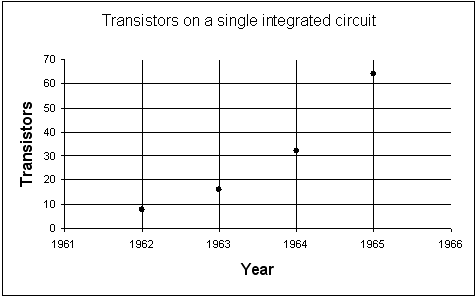
5. The following scatterplot shows the number of transistors that could be put on one integrated circuit in the years 1961 through 1966.

Transistors

a. Between 1962 and 1963, the number of transistors per integrated circuit increased by how many?
b. Between 1963 and 1964, the number of transistors per integrated circuit increased by how many?
c. Between 1962 and 1963, the number of transistors per integrated circuit increased by what percentage?
d. Between 1963 and 1964?
e. What kind of model is suggested by the answers to parts a) and b)?

Later today, I’ll post some suggested exam review questions. I’ll also have extra office hours:

  • Sunday (Feb 24), 1:00-2:30, in the UC lounge
  • Tuesday (Feb 26), time not yet determined, in my office

The exam is on Wednesday, February 27. Bring your Drew computer, and be sure you have a working copy of Excel 2003 or Excel 2007.

  • Homework to hand in: Section 1.5, exercise #14.

  • Homework to do, but not to hand in: Section 1.5, exercises 15, 17, 18

  • Read through section 2.1 of the text. (If you want, skip the topic “cubic modeling,” from the end of section 1.5. You won’t be responsible for that material.

Class will be held as usual. If the snow changes to freezing rain or other dangerous weather, I’ll update this post as needed. Commuters should stay off unsafe roads.

Because of a meeting, today’s office hour will be rescheduled to 11:10-11:45.

Please bring your laptop to class on Friday.

Reading:

  • Section 1.3 exercises 25, 26, and 29 [parts a, b, and d] Attempt the exercises if you have time, but the important thing for Friday is to read and understand the questions.
  • Textbook section 1.4. Skim it for Friday, and read it again more thoroughly for Monday.