Author Archive

1. What should you bring to the exam?

Required:

  • A laptop with a working version of Excel. (If your battery works, charge it. I’ll bring a power strip so there’s more places for Juniors and Seniors to plug in.

Recommended:

  • A calculator. (I will bring a few loaners.)
  • A two-sided reference sheet (or two one-sided sheets) of formulas, notes, examples, etc.

2. On the Excel practice problems, you might have encountered a confusing situation. Here’s a description of the issues, in case they affected you. They won’t come up on the actual final.

First issue:
(This is a bug in Excel 2007 that only affects some users.) For the "Cincinnati population" question, a wrong number may be displayed in the trend line equation. When this happens, the model you get is wrong, and the projections probably make no sense, even if you use a calculator.

This problem occurs when the model equation contains a six or seven-digit coefficient.

You can avoid this problem by entering "thousands of people" instead of "people" in the spreadsheet.

Second issue:
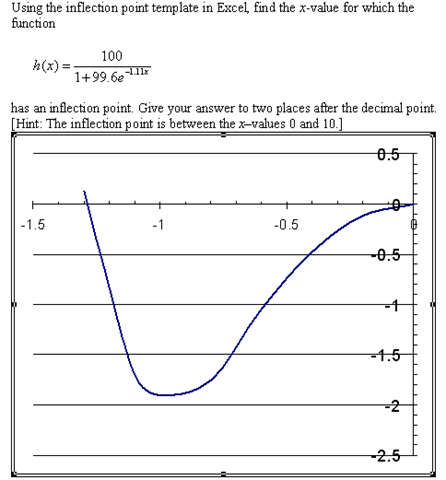
In the inflection point question, there may be a "tie" for the largest first difference. This situation never came up in class, so you may not know which interval to "zoom in" on. When it happens, it doesn’t matter which of the two biggest first differences you choose. As you zoom in, the additional digits of the inflection point might be 000… or 999…, which in a different situation might make you think you made a wrong choice. Again, this shouldn’t happen on the actual final exam.

Apologies for posting this yesterday to another blog. :(

1. Page 37, #17a,b,c. [Hint: "increasing at a constant rate" means the same thing as "increasing linearly."]

2. Page 82. Look at the data in question 17. Recall that when data changes by about the same percentage difference across equal intervals, an exponential model may be a good choice. If the 1st differences are close to each other, a quadratic model may be a good choice. If the 2nd differences are close to each other, a quadratic model may be a good choice.

a) Find the percent differences for this data:

From age 40 to age 45, the death rate increased by what percentage?
From age 45 to age 50, the death rate increased by what percentage?
From age 50 to age 55, the death rate increased by what percentage?
From age 55 to age 60, the death rate increased by what percentage?
From age 60 to age 65, the death rate increased by what percentage?

b) Find the 2nd differences for this data (remember, the 2nd differences are the 1st differences of the 1st differences. There will only be four  2nd differences for the 6 numbers here.

c) Find the 1st difference for this data.

d) Rank the three possible models (exponential, quadratic, and linear) from best choice to worst choice based on your calculations.

e) [more challenging] Using a calculator if you need, but without Excel and without calculating the actual model, estimate the death rate at age 70 assuming an exponential model. Do this again, assuming a quadratic model.

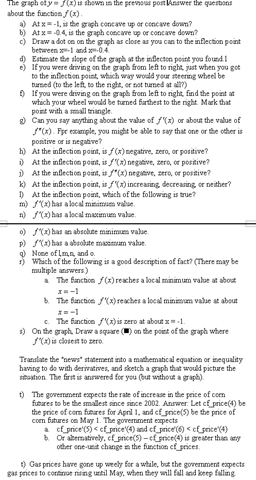
3. Page 126: Consider the graph in exercise 30. Write T for temperature and E for emergence, so the function graphed is E(T). Label points on the graph as follows:

a) Label as P the inflection point between temperature 15 and temperature 25.
b) Label at Q the point where E”(T) appears to have the smallest value (most negative).
c) At P, is E(T) positive, negative, or zero?
d) At P, is E'(T) positive, negative, or zero?
e) At what point is E'(T) the largest (the most positive)?
f) Estimate the slope of the graph when T = 20.


The following questions cover topics we spent relatively little time on in class. On Friday’s exam, you will have a choice among these problems, so if you know one of the topics better than the others, you can choose it

4. Page 275, #7 and #15

5. Page 253, #23a,b.

6. Let H(t) represent housing prices t months into this year (1 = January 2008; 2 – February), Earlier this year, housing prices were falling at a steady rate. Can you say whether H'(1) is positive, negative, or zero ( t = 1 means’ January.

Later, from March until June, prices were not only falling from month to month, they were falling faster and faster each month. Can you say whether H”(4) is positive, negative, or zero?

The attached Word file contains some Excel review questions for the final. (I hope to post some non-Excel questions a bit later.)

Final exam Excel review

Click on the link below to see the exam 3 review questions (the same questions already posted here) as a Microsoft Word document.

Exam 3 review

I’ll the in the UC Lounge (or nearby if it’s noisy) from 1:30-3:00 today.

SK

image

  image

Excel:
  a. Finding an inflection point numerically
  b. Income streams
     i. Future value of an income stream, given a rate of investment (payment rate).
    ii. Rate of investment (payment rate) required to reach a future goal.

Non-Excel:
  a. Algebraic Derivatives, in particular those that use the chained version of
     derivative rules.
  b. Related rates, using the following outline.
     1. Write the equation relating the relevant quantities
     2. Take the derivative of this equation.
     3. Use the information provided to find as many values and rates of change as you can
     4. Solve for the unknown rate of change, which should be the only remaining unknown.
  c. Interpreting second derivatives and inflection points (e.g., "growth rate has peaked")

Remaining for final exam:
  a. Notation for total accumulation (the "definite integral")
  b. The fundamental theorem of calculus:
       Future value equals initial value plus accumulated change.
       F(<end time>) = F(<beginning time>) + accumulation from beginning to end of F'(t).
       Accumulation from beginning to end of F'(t) = F(<end time>) = F(<beginning time>).
       Accumulation from beginning to end of g(t) can be found in two steps:
         1. Find a function F so that F'(t) = g(t).
         2. Compute F(<end time>) – F(<beginning time>)

For several reasons, I’m postponing exam 3 until Monday, April 29. We can then use part of Friday’s class as a "lab" to practice Excel skills before the exam (so bring your laptop on Friday). And I’ll hold weekend office hours to help compensate for the office hours I’ve rescheduled around meetings lately.

If the postponement is a problem for you, please let me know.

For Wednesday, please turn in solutions to these exercises
Section 3.4: 9, 11, 15, and 31.

Also, read section 4.4 of the text.